Showing posts with label God. Show all posts

Friday, March 14, 2014

Friday Findings: Speaking the Truth in Love

I really enjoy sharing these awesome blogs known as Friday Findings!
Tonight's FF comes from Matthew Shallenberger's blog: In This Atmosphere.
I'm following this blog and it's been SUCH a huge blessing, I know you'll benefit from it too.

EF

Speaking the Truth in Love
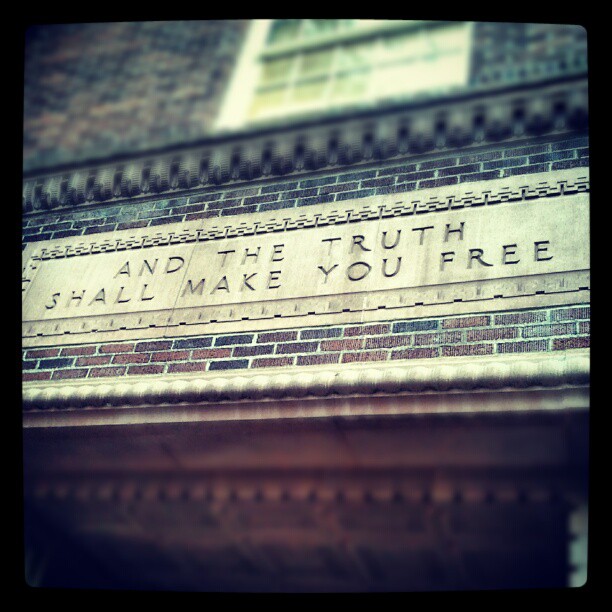

“Instead, speaking the truth in love, we will grow to become in every respect the mature body of him who is the head, that is, Christ” (Eph. 4:15).
What does it mean to speak the truth in love? How do we confront people with the convicting testimony of God’s Word while remaining compassionate and caring? Is it a matter of somehow balancing truth and love (as if they’re competing concepts)? Is it a matter of presenting truth in the most loving way possible? Are there times we hold back the truth in order to be loving?

Some will insist that the most loving thing to do is to tell the “straight testimony” without pulling any punches. If people have a desire to know and follow the truth, then it won’t matter if our presentation is a little rough around the edges. We shouldn’t be concerned with pleasing the masses. Truth confronts and convicts, so just let ‘em have it, and let the chips fall where they may.

Truth does indeed confront and convict; there’s no doubt about that. But there’s a question that has been nagging in my mind for a little while now. It comes from putting together a couple of fundamental biblical principles. The first is found in John 14:6: “Jesus answered, ‘I am the way and the truth and the life. No one comes to the Father except through me.’” Truth is actually a Person—Jesus Christ—and not merely a set of facts. So if I really want to tell people the truth, I have to introduce them to Jesus.

The second biblical principle comes from 1 John 4:8: “Whoever does not love does not know God, because God is love.” Not only is Jesus the truth, He is also love. So here’s the question: If I speak the truth, but not in love, is it still the truth? In other words, if my presentation of the truth fails to convey the love of Jesus, then I’ve left out a fundamental aspect of God’s character. And if I’ve misrepresented God’s character, then have I really communicated the truth, since Jesus, and not mere facts, is the truth?

Now, the “straight testimony” folks would probably argue that we could take this love thing to an extreme and never really confront sin because we’re too busy trying not to offend. They have a point—but only because we humans have a hard time understanding what love really means. Loving someone does not mean enabling them to continue doing what’s wrong. We don’t need to counterbalance love with truth, or vice versa; rather, we need a right understanding of God’s love.

So the question remains. My belief right now is that if I merely present a set of facts but I don’t demonstrate the love of Jesus, then I haven’t actually spoken the truth at all. I’ve only misrepresented the truth, because I’ve reduced it to mere propositions. Those things don’t cease to be true if I don’t speak them in love. But I haven’t actually spoken the whole truth if I don’t speak it in love.

Believing in facts will not save us; believing in Jesus will. I challenge you to consider how you speak the truth to others. Are you presenting truth the Person, or truth the proposition? Look at the last part of Ephesians 4:15, the verse I quoted in the beginning. It says that the goal of speaking the truth in love is for all of us together to mature into the body of Christ. We will become like Jesus! Let’s imitate His example. That’s the best way to ensure that we’re always speaking the truth in love.

Friday, February 28, 2014

Friday Finding: A Life Long Battle with Legalism

Friday Finding slidding in JUST before midnight so it still counts!
It's been a LONG week and I know this will bless you the way it blessed me.
Thanks for the great content Marcos!

Click here to go to the original post.

Wesley's Faith-Journey: A Life Long Battle with Legalism

photo credit: Vu Bui via photopin cc

The following is a book review I [Marcos] wrote on the book "John Wesley, A Biography" by Stephen Tomkins.

John Wesley, A Biography, written by Stephen Tomkins, is an excellent biography of John Wesley, one of the fathers of evangelicalism. Tomkins, though negatively biased toward Wesley's theology, brings an authentic flavor to the telling of his story. Rather than presenting him as a hero without warts, Tomkins pours through Wesley's journals and stories in an attempt to paint the man as realistically as possible. The end result is a picture of a man far from perfect-though he preached perfection-and far from confident in his walk with God-though he preached faith. And yet, we also see a man so committed to Christ that few have ever matched his sacrifice and zeal for the work of the gospel.

John Wesley, A Biography is a chronological retelling of the life of Wesley. Tomkins looks not only at Wesley's teachings and adventures as a Methodist preacher, but also his childhood, love life, emotional life, spiritual journey, and family relationships. Due to lack of space I will focus on that which is of most interest to me: his faith journey and his lifelong battle with legalism.

John Wesley was born into an Anglican family that was, for lack of a better word, dysfunctional. According to Tomkins, Wesley's father, Samuel Wesley, once separated from his wife, without intending to return, because she did not support the new king of England and would not pray for him. "You and I must part," said Samuel, "for if we have two kings, we must have two beds" (10). But after his house nearly burned down during a visit Samuel decided to stay and take care of his family. "Less than a year later, on 28 June 1703, John Wesley was born" (11).

Wesley's childhood was loving, but stringent. According to Tomkins, his upbringing was exceedingly strict even by the standard of his day. Susanna, Wesley's mother, believed that children were naturally wicked and rebellious. As a result, Susanna sought to do a type of behavior modification by forcing her children's wills to incline toward good. Her parenting philosophy is summarized in her own words: "Break the will, if you will not damn the child" (13). Tomkins writes:

Susanna... [Wesley's mother] allowed 'no such thing as loud talking or playing'... When turned a year old (and some before) they were taught to fear the rod, and to cry softly... to be still at family prayers, and to ask a blessing immediately after meals, which they used to do by signs before they could kneel or speak... By the time they were grown, they all knew vast tracts of the Bible, some of them whole books, by heart. At meals times the children sat at a small separate table... They were allowed nothing to eat or drink between meals and were beaten if they asked... (12-13).


The strictness of his childhood did not end with adolescence or even adulthood. As a young man, before his conversion, Wesley dedicated himself, while studying at Oxford, to living a holy life. With holiness as his ultimate goal in life Wesley became quite fanatical. Of this time Tomkins writes, "he grew ever stricter on himself, writing a new self-catechism to review not only his daily deeds but also if his motives were sufficiently directed to the glory of God. He discouraged visitors to his room who might waste his time, and abandoned such frivolities as cards and dancing" (32). And yet this was only the beginning. Tomkins describes the evolution of Wesley's fanaticism stating, "As his goals were elevated, his self-analysis and self-discipline were turning into obsessions... He now updated his spiritual audit on an hourly basis and not only noted his successes and failures, but gave himself a score out of nine" (38).

This severe approach to Christianity continued for many years. However, events in Wesley's life began to change his theology and reveal to him a more joyful religion. It all began with Wesley's missionary voyage to America. During the journey Wesley's ship was caught in a fearful storm. Wesley feared for his life but he noticed a company whom didn't seem frightened at all. Wesley inquired as to the source of their super-natural peace and discovered them to be Moravians; followers of Luther, whose religion placed an "emphasis on justification by faith that the English church [to which Wesley belonged] had lost" (46). It was this confidence in salvation that gave them peace in the face of death. However, it was not until much later, in the midst of another spiritual crisis, that light shone for Wesley as he heard a Moravian "reading from Luther's Preface to Romans" (61). The experience was to be a life changing one. Wesley writes:

About a quarter before nine, while he was describing the change which God works in the heart through faith in Christ, I felt my heart strangely warmed. I felt I did trust in Christ, Christ alone, for salvation; and an assurance was given me that He had taken away my sins, even mine, and saved me from the law of sin and death (61).


However, and here is where I appreciate Tomkins genuine portrayal of Wesley, this experience was not the end of Wesley's struggle with legalism. Unlike those who would like to romanticize Wesley's conversion, Tomkins has no quarrels with diminishing its grand impression upon Wesley's story by admitting that he continued, for the rest of his life, to bounce back and forth between grace alone and grace and works.

Some assume that Wesley was simply a legalist. According to Tomkins, "The traditional evangelical understanding of [Wesley]... is that he was attempting salvation by works" (43). This is said to be the case even after his conversion and is admittedly Tomkins bias. I however have a different theory. Having been raised in a similar fashion to Wesley I also have found it a great struggle to overcome my natural legalistic inclinations and trust in Christ alone for salvation even under the light of gospel freedom. Therefore, in my point of view, it is as a result of his upbringing that Wesley struggled with legalism most of his life. In short, I believe his struggle with legalism was due to psychological factors, not theological failure. The overbearing discipline instilled in his mind as a child formed a lifelong habit of fanatical austerity that he never, even under the light of gospel freedom, seemed to escape for long.

But how is it that the gospel was never able to set Wesley completely free from the Pharisee within? Apart from his natural tendency toward legal religion instilled into his childhood psyche by his legalistic mother, there is another factor that I believe to be the main culprit: Wesley never seemed to learn that faith and feeling are complementary, not synonymous. All of his life Wesley seems to have been dependent on his emotions to reveal to him the state of his soul rather than to depend fully and totally on the promise of God despite what his emotions told him. It is my theory that Wesley was inclined toward grace when he felt close to God, but whenever he felt far from God he would default to the rigid lifestyle of his earlier years as a way of feeling close to God again. The tragedy of this deceptive flaw is that even after years of enduring hardship, persecution, and deadly mobs for the cause of Christ, Wesley poured out his heart to his brother Charles saying:

I do not feel the wrath of God abiding in me; nor can I believe it does. And yet (this is the mystery) I do not love God. I never did. Therefore I never believed, in the Christian sense of the word... I never had any other evidence of the eternal or invisible world than I have now; and that is none at all... And yet I dare not preach otherwise than I do... I want all the world to come to what I do not know (168).


Tomkins is therefore right when he says, "What a desolate spectacle... It is pitiful to see his faith, even after all these years, still so dependent on the vicissitudes of his emotions" (169). This was Wesley's downfall. He never realized, at least in an experiential manner, that feelings are never to be the grounds of our walk with God. They can come and go as easily as the wind shifts. We must learn to trust God's promises even when we cannot feel them to be true.

Even in the midst of this Wesley remained faithful to the Lord until his dying day. On Tuesday 1 March 1791 Wesley approached the end of his life. Weak, ill, and worn from a life of service he found himself unable even to write. "'After a last 'Farewell'', he died on Wednesday morning" (194).

While I have, up to this point, expressed my appreciation for Tomkins biography I do have one major point of contention with him: the way in which he dealt with Wesley's doctrine of perfection. Tomkins anti-perfection bias, in my opinion, prevented him from honestly assessing Wesley's true understanding of perfection. In his book A Plain Account of Christian Perfection Wesley clearly asserts that perfection is not the grounds for salvation and he distances himself, sometimes more and sometimes less, from the heresy of sinless perfectionism. Wesley's understanding of biblical perfection is "perfection in love". Wesley believed that Gods children can be perfected in love and have, what he refers to as "a purity of intention" and be free from "willful rebellion." Perfection in love, versus sinless perfectionism or absolute perfection which Wesley denied, is a concept easily found in scripture starting with Jesus who, after describing Gods love for his enemies said, "Be therefore perfect as your father in heaven is perfect" (Matthew 5:48). When Luke quoted the same discourse he substituted the word "merciful" for "perfect" indicating that perfection is not a state of flawless obedience to every minute command but having a heart that loves like Jesus loves. Tomkins seems to skip over these facts and instead focuses on the more fanatical concepts inherent in Wesley's perfection doctrine such as instantaneous perfection and the self-awareness of having attained perfection. He, therefore, gives the impression that he is eager to discredit the doctrine of perfection and fails to give it a fair hearing.

In conclusion, I found John Wesley, A Biography to be an excellent resource on the life of the father of the Methodist movement. Of all the aspects of his religious life I found his spiritual journey to be the most interesting. While I believe Tomkins analysis contains a slight anti-Wesley bias, especially when it came to Wesley's understanding of salvation and perfection, I nevertheless consider this work to be exceptionally done and worth reading for anyone who wants to learn more about the man, John Wesley.

___________
This book review was completed in partial fulfillment of the course Church History II at Southern Adventist University. Originally published in Ezine Articles: Article Source:http://EzineArticles.com/8321138

Wednesday, February 19, 2014

Is the Investigative Judgement biblical, or did Ellen White just make that up?

So, this blog is in no way meant to be a comprehensive, exhaustive study on the Investigative Judgment. There are plenty of other materials from smarter, more well-versed scholars. BUT since you're still reading this, I'm guessing you're interested enough to know more about it.
Thanks for pickin' a winner. ;)

First of all. . . 
Many people don't know what the Investigative Judgement is. Some think it's some weird, cult-y jargon exclusive to Seventh-day Adventist and assume that it originated with Ellen White because, hey, why not.
To some circles, the terms "Pre-advent Judgement" and "Investigative Judgment" can be interchangeable. We'll stick with the latter to avoid confusion.
We know that God will judge the world at the end of time, but what does that even mean?

What is the Investigative Judgment?
I would define the term to mean a judgment by God after he performs an open investigation. God is characterized as being fair and just.(Psalms 25:8) For this to be true, He must not be arbitrary, because that would not be fair. The sentence also must follow some sort of due process, or else He would not be just.

Is this thing even biblical?
There are many Investigative Judgments throughout the Bible. 
"Seriously, I didn't make this up!" -Ellen White

  • Beginning in Genesis 3, after the fall God asked Adam and Eve "what happened" (the investigation) before He pronounced judgment.
  • Genesis 11, God saw (investigated) that man was wicked and he passed judgment. At the tower of Babel, God “came down to see” (investigate) and then he judged.
  • In Leviticus 10 there is also an investigative judgment. Nadam and Abihu took strange fire “before the Lord”. A better translation of that would be “before God’s face.” This signifies that God saw (investigated) their apostasy and then pronounced judgment.

Are there any examples of Jesus mentioning something like this?
Jesus tells parables that involve an Investigative Judgment!

  • Matthew 22 tells of a wedding feast where the king comes in to see (Investigate) which of the guests are wearing the appropriate wedding garments.
  • The parable of the talents in Matt. 25 shows that the Master checked the work (investigated) before he judged and gave the rewards.

One last example!
The most compelling biblical example comes from the sin of Achan in Joshua 7. 
Achan takes what he’s not supposed to after a war. (No one was to pillage the losing people)
He returns to the camp with it and hides it under his family tent. God tells Joshua that someone had sinned and gives him a process and method of investigation. God tells Joshua to begin this process the next day.
The next day comes, lots are cast and Achan is found to be the one who sinned but the investigation is STILL not over.
The tribunal goes to Achan’s house where the illicit spools are discovered under his tent and THEN judgment is executed.
God allowed the judgment to be delayed because He still was giving time for Achan to repent!


What does this mean for us, today?!
Let the wicked forsake his way, and the unrighteous man his thoughts; and let him return unto the Lord, and he will have mercy upon him: and to our God, for he will abundantly pardon. Isaiah 55:7

Ellen White did not come up with the concept of the investigative judgment, God did.
This process highlights His justice, fairness and ultimately His love.
He has given us evidence of His righteous process all throughout scripture.

The good news is also that we have time TODAY to admit our sins, turn to Him and be forgiven! So that when His investigation is concluded, we could receive the reward of eternal life in His presence that He has promised!

Jesus puts it this way:
For God so loved the world that He gave His only begotten Son, that whoever believes in Him should not perish but have everlasting life. For God did not send His Son into the world to condemn the world, but that the world through Him might be saved.
He who believes in Him is not condemned; but he who does not believe is condemned already, because he has not believed in the name of the only begotten Son of God. And this is the condemnation, that the light has come into the world, and men loved darkness rather than light, because their deeds were evil. For everyone practicing evil hates the light and does not come to the light, lest his deeds should be exposed. But he who does the truth comes to the light, that his deeds may be clearly seen, that they have been done in God.
-John 3: 16-21
For more information about the Investigative Judgment, Click HERE!

Peace and blessings,
EF 

Friday, February 14, 2014

Friday Findings (No Love... No Point!)

Today's FF is FIRE from the altar of God!
If you have 5 extra minutes to be inspired, take a look around the original post and be blessed.

Thanks for sharing your thoughts, Tina.

CLICK HERE to see the original post. :)

No Love...No Point!

My teacher made our class read a online article called "Godless Cities," where it named the top two Godless cities and the top Bible minded city. To my surprise, Chattanooga TN was ranked as the top Bible minded city. Actually most of these southern states are known as the "Bible belt." But what was interesting is that my teacher made a point of saying that it's ironic that these Bible belt states are the same ones who were supportive of slavery. 

Aside from how the author of the article defined "bible minded," I was really stuck in thought by his statement. It caused me to think, what difference does it make if anyone's city is considered to be the top Bible minded place? The reality is, Chattanooga made the list but Chattanooga still has a serious gang violence issue. Chattanooga still has crime. There are still homeless people in Chattanooga. Chattanooga has corporate greed. There are still prostitutes in Chattanooga. There are abused women and drug users in Chattanooga. Chattanooga still has racist and prejudice residents. Murders still take place in Chattanooga. Sexual immortality is still a reality in Chattanooga.

I don't even know the official numbers but Chattanooga has churches on almost every corner of this city. It's like people wake up and randomly decide to start a church. That's how many churches this place has. 

But the question is, has being bible minded and having churches on every corner, turned this city into a place that reflects true disciples of Jesus? 

The Bible does not say that people will know that we are His by how many Jesus t-shirts we wear. Bumper stickers we put on our cars. Flags we place on our porches. Buttons we wear on our suits. Commentaries we have on our shelves or any of that stuff. 

The Bible says "By this all men will know that you are My disciples, if you have love for one another." (John 13:35 NASB). 

This is THE sign! This is the TEST. This is the list that we should be striving to be on. It makes no difference to be Bible minded but not truly transformed by the word of God. And the evidence of our transformation is LOVE.  And if we love one another the way Christ loves us, a lot of the foolishness that happens in this Bible minded Chattanooga will slowly but surely be issues of the past. 

Friday, February 7, 2014

Friday Findings

Here's a great blog that NEEDS to be read!

Our late finding today comes from a new blogging team with stellar skillz and a real passion for Christ!

This is the link back to the original post.

When Mountains Explode...

            On May 18, 1980, Mt. St. Helens erupted. Located in South-Western Washington State, St. Helens had been seen as one of the most beautiful and peaceful sights in the Pacific Northwest. The mountain is one of several large volcanic peaks that make up the Cascade Range. Other prominent peaks include Mt. Rainier near Seattle, Mt. Hood near Portland, Oregon, and Mt. Shasta in Northern California. At its base was a picturesque lake where visitors camped and fished. The mountain was taken for granted, a landmark for people seeking escape from the constant buzz of city-life. It took but a moment for this vision of splendor to erupt in ash and magma.             
            For two months, geologists had known something was coming. Small earthquakes, a visible bulge on the surface of the mountain, and other anomalies hinted at the power stirring beneath the earth. Yet the fury of the final eruption astonished everyone.
The picture of Mt. St. Helens Eruption I remember
from my parents coffee table book.
            Throughout the spring as the mountain had been rumbling, the snow that clung to its sides had been slowly melting, continuing a cycle as old as Creation. The melting snow seeped into the earth. On May 18, as the pressure of the white-hot magma bulged upward an earthquake suddenly occurred and the spring-soft face of the mountain gave way. One of history’s largest landslides released two hundred years’ worth of volcanic pressure and sent a molten cloud of steam, ash, and magma rocketing across the countryside at nearly the speed of sound. It leveled everything in its path and radically changed the landscape. What had once been a peaceful recreational area at the base of a beautiful peak became a post-apocalyptic wasteland in minutes. Trees were leveled for miles, then stripped of all foliage even further away. Pieces of heavy machinery were tossed into the air like children’s toys. The beauty, stability, and majesty of the mountain was destroyed.

            Growing up, my parents had a coffee table book that detailed the eruption. I remember being fascinated by it. It had amazing pictures of the eruption and the resulting devastation. One set in particular showed the mountain as it had been, then the landslide beginning, then the landslide continuing as the first evidence of the eruption begins, and finally the eruption overtaking the peak itself.
            Today the peak that was once visible over 200 miles away is now a shadow of its former glory. And though plant and animal life has returned, the mountain will always be a testament to the ultimate fragility of all things.
Even now I find myself feeling a certain discomfort at the thought of a force powerful enough to detonate a mountain! Of all the features on this earth, mountains seem the most stable and indestructible. They seem to remain despite the onslaught of time and nature. Yet they are not impervious to all attacks as Mt. St. Helens clearly shows.
Years later and 1700 miles away, I remember standing at the summit of Jackknife Mt. on the shore of Lake Aleknagik not far from Dillingham, Alaska. I was a staff member for the Alaska Camps program. This particular week we were at a camp called Polaris. It was the evening after the kids were gone and one of the counselors and myself decided we would climb Jackknife to see the sunset. In Alaska, the sun sets very late during the summer season and even after it has set it does not get dark. Because of this, my counselor friend and I reached the top near midnight, just as the sun was setting, all orange and pink.
As I stood there I felt utterly fragile. I was at the top of a mountain, surrounded by other mountains, looking at mountain peaks as far as the eye could see. Turning around, I saw massive storm cloud gliding silently toward us, towering above the majesty around us, dwarfing the tallest peaks, yet even it was subordinate for it glowed brilliant pink as it reflected the setting sun. Never in my life have I seen such majesty. I honestly doubt I ever will again this side of heaven.
The fact is, everything on Earth is at the mercy of something else. No matter how stable or how dependable it seems it must always bow before another. In that bowing, there is fear. Not the condition of being afraid, as one would feel about a violent criminal, but the all-consuming knowledge that what you bow to is what determines the fate of your existence. Just as the storm must bow before the sun and just as the St. Helens was powerless in the face of geological forces, so you and I must bow.
Where will you bow? Will you bow before your career, believing that your income will make or break your existence and living in fear of its wrath? Will you bow before the opinion of others, jumping through hoops to make them happy with you? Will you bow before your family, sacrificing freedom and individuality in the name of loyalty and “not rocking the boat”? Or will you bow before your Creator? Will you say with the inhabitants of Heaven,
“Worthy are you, our Lord and God,
to receive glory and honor and power,
for you created all things,
and by your will they existed and were created.”—Rev. 4:11

Everything on this Earth must bow before something. But He who created all bows before no one! He is the self-existent and self-sustaining Sovereign over all and only He is worthy of your devotion and only He is worth your devotion. You see He has the power to remove you from existence but the love to protect you from it at all costs. In a world where mountains can explode and lives fall apart, He remains the same “yesterday, today, and forever.”(Heb. 13:8)


Photo credit:

Gary Rosenquist accessed goo.gl/tdJ8h6